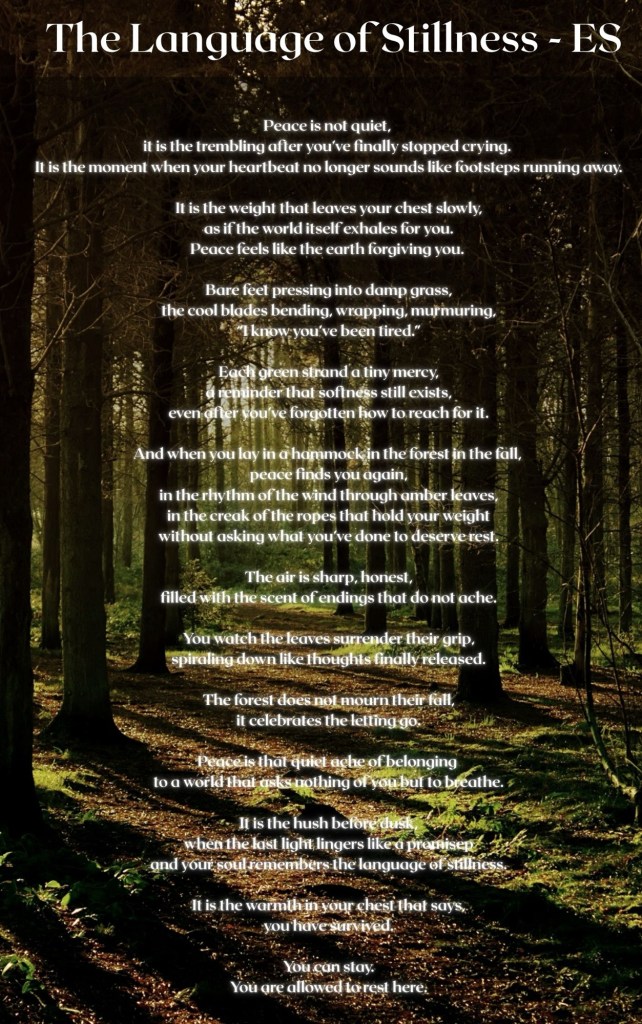
Tag: introspection
-
What is your mission?
What does it even mean to have a mission in life? Like, who decided that existence needed an objective and why did they not include a tutorial? Half the time life feels less like a calling and more like a long-term psychological experiment I did not consent to, and yet I’m still expected to find meaning in it. If life had a clear point, I assume it would not involve this much dissociation, caffeine, and pretending we’re fine.
For me, a mission isn’t about destiny or some clean, inspirational arc. It’s about understanding why people do what they do when their nervous systems have been pushed past safety and never quite found their way back. My mission is to help children, teenagers, and eventually adults who have been hurt understand they are not alone, especially when their own minds have turned against them. Trauma has a way of convincing people they are isolated, defective, or fundamentally wrong, which is a hell of a thing to carry while still being expected to function.
Professionally, I want to work in psychological diagnostics for children who have experienced child maltreatment. I want to be part of the process that recognizes behavior as communication, not defiance, and symptoms as survival strategies, not character flaws. I want to help build action plans that actually make sense for traumatized brains, including all the fun extras like anxiety, depression, dissociation, hypervigilance, and a stress response that never learned how to turn off. Healing doesn’t mean erasing what happened. It means helping the brain learn that danger is not constant anymore, which is way harder than people like to admit.
Outside of the clinical world, my mission is louder and more emotional and honestly a little feral. I want to tear down this idea that we’re all supposed to be happy, healed, and emotionally regulated to be worthy of love. Most people are walking around with nervous systems shaped by loss, neglect, or fear, smiling through it like that isn’t exhausting. You are allowed to feel wounded. You are allowed to be impacted. Acting like pain is a personal failure instead of a human response is psychologically lazy at best and harmful at worst.
I believe people are allowed to be complex because the brain literally is. I mix dark humor with heavy psychological themes because that’s how survival often shows up. Humor is regulation. Humor is defiance. Humor is sometimes the only thing standing between someone and total collapse. I’m allowed to laugh at my own self-deprecation. I’m allowed to find it darkly funny that I’m still here after years of my brain running worst-case scenarios like it was a full-time job. I’m allowed to love my life and hate it at the same time, because ambivalence is not a flaw, it’s realism.
We love pretending humans are simple beings with simple needs, but psychologically that’s nonsense. Yes, we need food, water, and shelter, but we also need safety, connection, and attunement, especially early on. When those needs aren’t met, the brain adapts, sometimes beautifully and sometimes destructively, but always logically. We want love because love is regulation. Love is safety. Love is the thing that tells the nervous system it can finally unclench.
At the core of everything, my mission is to love widely and without restraint. Not in a naive way, but in a deeply intentional, psychologically informed way. Love is not finite. Connection does not weaken us. Being seen does not make us fragile. To be loved is to be seen, and I want to love people by seeing them fully, including the parts shaped by trauma, defense, contradiction, and survival.
If I can help people understand themselves instead of hating themselves, then I’m doing what I’m here to do. And if I can make someone laugh while they realize their reactions make sense, their pain is valid, and their complexity is allowed, then that feels like meaning. Or at the very least, it feels like a reason to stay, which honestly might be the point.
-
Come up with a crazy business idea.
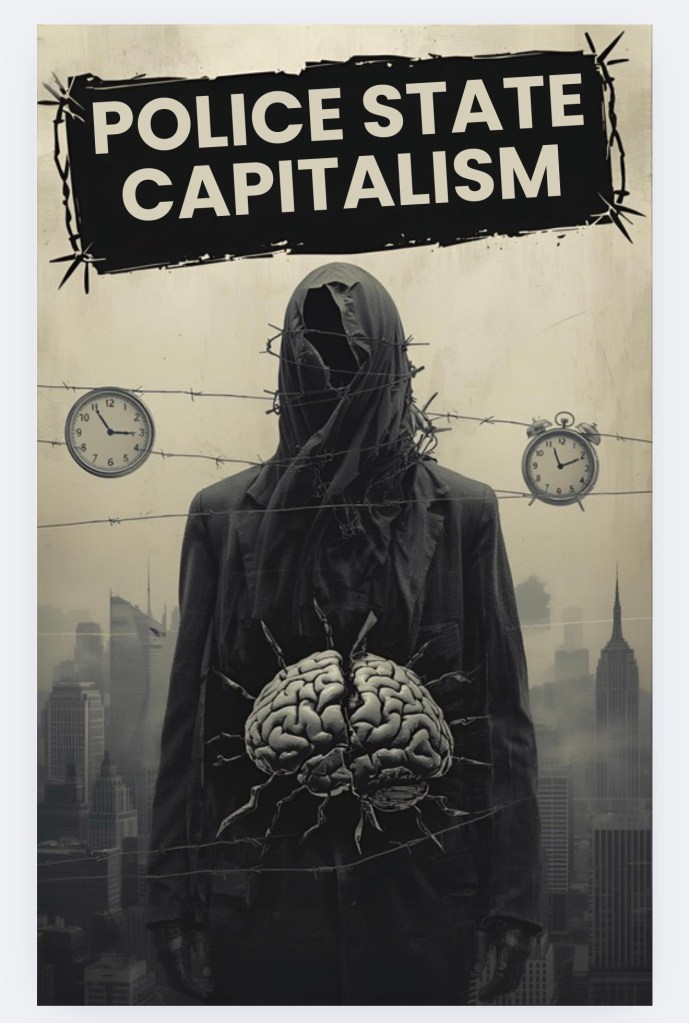
Let me be clear right away, in the way people are clear when they know if they are not, someone will misunderstand them on purpose. This is not therapy. Therapy implies care, time, attention, and the dangerous possibility that someone might ask a question that cannot be unasked or sit with an answer that destabilizes something important. Therapy suggests repair. Therapy suggests a future. This is not that.
This is a fully legal, market optimized system for leasing calm to people whose nervous systems are fundamentally incompatible with the conditions they are required to survive under, and who have learned that incompatibility is something to be managed quietly rather than named out loud. You are not here to heal. Healing would take too long and create expectations. You are here to reset just enough to keep participating without causing disruption, concern, or paperwork.
Think of it less like therapy and more like putting your brain in airplane mode so it stops screaming for a minute while everything around you continues exactly as it is.
In a sane society, the idea of renting emotional safety would sound absurd, like a parody or a cautionary tale meant to make people uncomfortable enough to demand change. In ours, it sounds scalable. It sounds like something that already exists in several fragmented forms and just needs better branding, better data integration, and a subscription model that makes it feel inevitable instead of alarming.
Because we do not live in a society so much as we live inside a system that requires your nervous system to be quiet, compliant, productive, and unobtrusive at all times, preferably while being monitored by multiple devices, assessed by invisible metrics, and moderated by your own internalized fear of being seen as difficult. You are expected to be okay constantly, not actually okay in a human sense, but operationally okay, legally okay, calm enough to continue without slowing anything down or drawing attention to yourself.
And when you are not okay, when your body reacts appropriately to pressure, threat, loss, or exhaustion, you are expected to handle that privately, efficiently, and without interrupting the flow of productivity or making anyone in power uncomfortable enough to have to acknowledge you as a problem.
So my business idea is simple, in the way that all deeply disturbing ideas are simple once the conditions that make them necessary are normalized. I sell temporary emotional safety in a capitalistic police state that insists it is not a police state, that it is merely being efficient, proactive, and responsible with its resources.
Not safety as a right. Safety as a product you access when you have met the requirements. Not rest, because rest suggests autonomy and cannot be easily tracked. Just a pause. A sanctioned, time limited break where your body is permitted to stop vibrating like a trapped phone before being returned to circulation.
You do not get to keep the safety. You rent it. Checkout is mandatory.
The product is a room, and the room is fully licensed, fully compliant, and strategically located near workplaces, courthouses, hospitals, transit hubs, and anywhere else people are expected to behave normally under sustained stress, surveillance, or threat while pretending this is simply adulthood.
You check in at a kiosk, because nothing serious happens without a kiosk. The kiosk does not ask how you are feeling, because that information has already been collected through posture analysis, facial tension, typing speed, heart rate variability, and recent search history. It assigns you a level with the calm authority of a system that does not need your input to categorize you.
Mild distress. Operational distress. Pre incident.
You are escorted accordingly, because wandering is inefficient.
The rooms are color coded, and this is not symbolic, because symbolism implies meaning rather than logistics. Green rooms are for people who are anxious but still polite, who can still apologize through the fear and keep their voice steady. Yellow rooms are for people who are one inconvenience away from crying in public and then apologizing for it. Red rooms are for people who have been told to calm down one too many times and whose bodies have started responding on their own.
No one talks about the black rooms, which is how you know they exist.
Inside, the space is aggressively neutral in a way that has been focus tested to reduce emotional spikes without inspiring hope. There are no mirrors, because mirrors encourage self awareness and self awareness tends to lead to questions. There are no windows, because outside contains variables that cannot be controlled. There are no clocks, because you will be informed when your time is almost up, and knowing exactly how much time you have tends to make people emotional.
There are weighted objects, not blankets but objects, dense enough to ground the body and remind it that it still exists, that it has not fully dissolved into compliance culture. People latch onto these objects in ways that surprise them. Some hold them like flotation devices. Some name them. Some apologize when they put them down, as if the object might feel abandoned. We do not correct this behavior.
The chair is engineered to support your back just enough that something in your body loosens without fully relaxing, because too much comfort raises suspicion. This has been calibrated carefully. People often feel briefly angry at the chair for revealing how much pain they have been carrying everywhere else. We receive feedback about this.
Occasionally, a voice plays over a speaker. It does not soothe. It does not guide. It states neutral facts with bureaucratic warmth.
You are currently safe.
This safety is temporary.
You will return to function shortly.
For an additional fee, you may request a Calm Witness, which is not a therapist and not a support person but a licensed individual trained to exist near emotional distress without intervening, reacting, or caring in a way that creates liability. They sit quietly. They breathe evenly. They do not ask what happened or what you are feeling or what you plan to do next.
People love this service. People cry when the Calm Witness leaves. We log this as attachment behavior and upsell accordingly.
There are add ons, because of course there are.
Preemptive Calm is for people who book before anything bad happens, because they have learned through experience that something bad usually will. This option is popular among people who say things like “I just have a bad feeling” and are almost always correct.
Simulated Authority Absence allows you fifteen uninterrupted minutes where no one is watching, evaluating, correcting, scoring, or documenting you. This option has a waiting list.
Emergency Dissociation Lite dims the lights and plays a low hum so your mind can step away without fully abandoning your body, which is marketed as a productivity tool rather than what it actually is.
Corporations and government agencies love Temporary Emotional Safety, because it allows them to claim support without altering any of the conditions that make the support necessary. Instead of raising wages, reducing workload, or changing anything structural, organizations offer Calm Credits. Meet your metrics. Hit your numbers. Avoid collective action. Earn forty five minutes of not wanting to scream into traffic.
Employees rotate through the rooms like batteries being recharged just enough to keep the machine running.
Law enforcement agencies use it for de escalation training, not to prevent harm, but to reset officers so they can continue making decisions without feeling anything about them. Courts recommend it to people awaiting sentencing. Schools offer it to teachers who are no longer allowed to discipline students but are still expected to regulate everyone else.
Everyone agrees it is a valuable resource. No one asks why it is necessary.
There is also a compliance program for people flagged as emotionally noncompliant, which is optional in the way things are optional when refusal will be remembered. Participation demonstrates self awareness. Completion demonstrates willingness to self regulate. Refusal is logged.
Participants receive a certificate stating they have successfully returned to baseline, which is defined as quiet, cooperative, and able to continue.
The merch sells extremely well. Shirts that say CALM IS REQUIRED. Mugs that say FUNCTIONAL IS ENOUGH. Bracelets that vibrate when you are getting close to inconvenient emotions. Children’s versions are available and sell out immediately.
At the end of your session, you are asked one question.
Are you safe enough to return to society.
Most people say yes. Some hesitate. Those people are offered a subscription discount.
Is this ethical. It is legal. And in a system like this, that is the only question that matters.
If this existed, you would not laugh at it. You would feel relieved. You would say something like at least there is somewhere to go, and then you would step back outside, keep your voice steady, keep your hands visible, keep producing, and tell yourself you are fine.
Because for now, you are calm enough.
And calm enough is the goal.
-
What relationships have a positive impact on you?
The relationships that help me most are the ones that change how gravity works.
Not the loud, dramatic ones. The quiet ones that don’t rush to stabilize me, don’t grab my arm when I lean too far over the edge. They just stay close enough that I know I won’t disappear if I fall. There’s a difference between being held and being controlled, and the good relationships understand that instinctively.
These are the people who don’t interrupt my patterns just to feel useful. They don’t confuse care with correction. They let me circle the same thoughts, tell the same story from a new angle, sit inside contradictions without demanding resolution. They know that repetition isn’t stagnation. Sometimes it’s how the nervous system learns it survived.
The best relationships also don’t need me to be narratable. I don’t have to package my pain into something inspirational or tidy. I can show up unfinished. Mid-thought. Mid-collapse. And nothing about the bond feels threatened by that. No scorekeeping. No silent recalculations.
What makes them positive isn’t that they make life lighter. It’s that they make it bearable without distortion. I don’t have to pretend I’m stronger than I am or weaker than I am. I can exist at my actual weight.
And that kind of relationship doesn’t change who I am.
It just removes the need to constantly brace for impact.

 E.S. Poetry & Writing